~20
active agents
Across LFG and its sister company, up from a single pilot agent in the spring.


Landfill Group started with one experiment. Within two months, employees across the company were finding and building their own ways to use AI at work.
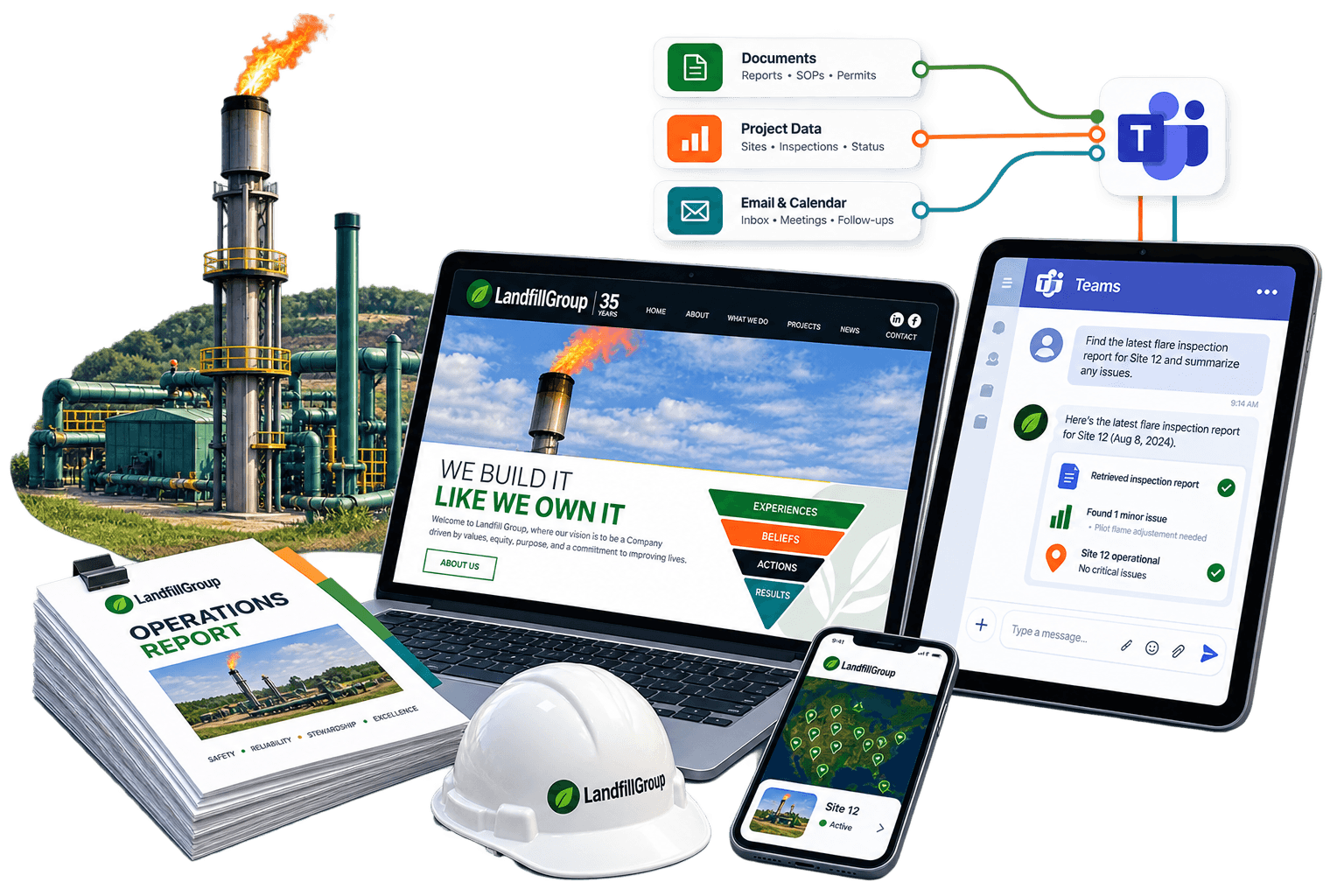

“The results have honestly blown us away. We started this thinking we were bringing AI into the company to help our people work more efficiently. It's become so much bigger than that. Our team is finding ways to use these agents that we never would have thought of at the beginning, people are asking to get access, and work that used to take hours is getting done in minutes. The more we use it, the more opportunities we see. Mountain Dev didn't just hand us an AI tool and walk away. They've learned our business, built this around the way we actually work, and kept pushing with us to figure out what's possible next. I really feel like we're getting a glimpse of where business is headed, and we're getting there ahead of a lot of companies.”
Landfill Group didn’t start with a company-wide AI strategy or a list of agents they wanted us to build. We started small, worked alongside their team, and proved that AI could make real work easier.
Once employees saw what was possible, they started finding opportunities themselves.
Finance saw opportunities. Legal saw opportunities. Operations, sales, admin, and the fab shop did too.
Within two months, Landfill Group had gone from one AI experiment to nearly 20 AI-powered workflows across the business.
Mountain Dev didn’t come up with all of them. Their employees did.
That’s the part that matters.
Adoption stopped being something we delivered and became something they pulled.
Nearly 20 workflows. Multiple departments. Real work happening differently within two months.
But the bigger result was behavioral: AI stopped being something the company was experimenting with and became something employees knew how to use.
~20
active agents
Across LFG and its sister company, up from a single pilot agent in the spring.
12+
employees with their own agents
Spanning finance, accounting, operations, legal, sales, admin, and the fab shop.
<2
months from zero
From no AI tooling in the business to org-wide, employee-driven adoption.
~1 hr
to activate a new agent
Roughly $100–200 all-in, making the marginal cost of adding a worker trivial.
Any pilot can look good in its first few weeks — usage numbers are easy to inflate with enthusiasm. What makes the signals below different is that each one cost Landfill Group something real: money, a staffing decision, or a change in how the team works. That is a much harder thing to fake than early excitement, and it's why we're confident this is durable adoption rather than a honeymoon phase.
Usage has roughly doubled month over month since.
Staff have proactively asked for seats after seeing colleagues' results. Adoption is being pulled through the organization, not pushed onto it.
Rather than waiting for handed-down automations, employees are designing their own agent workflows and documenting them so the work can be handed over.
The value wasn’t just hours saved. By absorbing routine IT work after an employee departure, AI helped delay — or potentially eliminate — the need for an immediate replacement, creating meaningful operational savings.
AUTOMATE
Monthly budget and AP reporting, rebuilt end to end by the person who owned it.
LFG's AP/Finance lead rebuilt monthly budget reporting on her own agent: raw QuickBooks exports go in, and formatted budget reports with favorable and unfavorable highlights come out, filed automatically to SharePoint.
What makes this a capability rather than an automation is how it happened. She designed the workflow herself, then asked Claude to document how she would teach it to someone else — and handed the whole process to the agent.
Asked whether the agent did the job as well as she had done it herself, her assessment was that it was technically better.
— AP/Finance lead, Landfill Group
MODERNIZE
A data cleanup that turned into the engagement's largest production workload.
The fab shop's Job Boss data cleanup became an AI-accelerated project: agents were used to design and migrate a new part-numbering system, with more than 36 hours of data migration executed with agent assistance in a single month.
The resulting agent now handles vendor pricing uploads, creates part numbers according to the naming convention, and maintains pricing archives. Scheduled supplier outreach is the next step.
Roughly 90% of early AI usage spend went to this effort — an indicator of real production work rather than experimentation.
ABSORB
The clearest ROI storyline in the engagement.
When a departing employee's responsibilities needed a home, LFG chose to absorb the role with a combination of Mountain Dev and agents rather than rehire.
Agent-assisted takeover meetings and workflow documentation are underway, with the expectation of being net cash-positive against the salary it replaces.
AI adoption directly offsetting headcount cost, rather than adding to it.
Monthly budget and AP reporting automated end to end, with output quality rated better than the prior manual process.
A departing employee's role absorbed by agents and Mountain Dev, at expected net-positive cash versus the salary.
75-page RFPs scored against a matrix, with responses drafted to roughly 80% complete.
Regulatory and permit data, including state notices of violation, pulled into dashboards for project evaluation.
The integration agent alone unblocks about two hours a week; email triage and spreadsheet updates in community impact are now agent-handled.
Adoption extended beyond LFG into its sister company, covering retail and hospitality staff across three locations.
Per-worker time savings are not yet instrumented across the program. A usage-analytics workstream is on the roadmap, and we would rather report the measures we can stand behind than estimate the ones we cannot.
The real outcome wasn’t the number of agents.
It was that people across Landfill Group learned what AI could do, started recognizing opportunities in their own work, and had the confidence to act on them.
That’s what we’re trying to build with our clients: not dependence on Mountain Dev, but a team that gets increasingly capable with AI.
Mountain Dev has spent years building software for other organizations. This is the first practice we have built by applying the approach to our own business before selling it — mapping how our own work flows, finding where our own process was the constraint, and instrumenting what we could measure.
That is also why this page is shorter than most case study pages. The engagement is real and ongoing, the numbers above are the ones we can substantiate today, and we would rather publish a narrow set of defensible results than a broad set of impressive ones.
The evidence should outlast the enthusiasm.
They may just need someone to help them see what’s possible and get the first few wins under their belt.
Let’s find the first one.
Results like these start with a few useful wins. We work alongside your team to find where AI can make a real difference, put it to work on something that matters, and help your people build the confidence to keep finding opportunities themselves.
Explore an AI partnershipA focused executive discussion about your goals, current systems, and whether there is a sensible low-risk place to begin.
Start a ConversationMountain Dev
Helping businesses turn technology into advantage.